2024: What’s happening in Porto Alegre and in Rio Grande do Sul
Hello friends.
I am writing this story to share what is happening at “my home”, the “beloved city” from which I left, Porto Alegre, in the state of Rio Grande do Sul in Brazil. It will be a bit long, but I hope to tell a little bit of what is not said or shown here in Italy.
First, some general information: Rio Grande do Sul (RS) is Brazil’s fourth largest economy, and has about 11 million inhabitants, with about 1.4 million in the city of Porto Alegre (POA) alone. The state produces 70% of the rice consumed in Brazil, 8.5% of soybeans, and also stands out in cattle breeding as the third place for chickens and pigs, the fourth largest egg producer and the fifth among milk producers. Who never tasted our Picanha ?? RS is also a very large state, its territory (282,000 km²) is equivalent to almost the entire Italian territory (302,000 km²). Keep these dimensions in mind to evaluate what follows, which is not the most important thing: fields are recultivated, animals are reared, houses and shops are rebuilt. But the lives of those involved, including my dear friends and family, well no, these will remain with an indelible mark. There have also been many victims, still many missing and still municipalities completely under water where it is not known what will be found when the water subsides. I thank God that no one in the family and among the closest friends lost their lives, but the stories of the rescuers, especially in the innermost municipalities, are shocking; I did not have the courage to continue on many videos. The search continues even at night.
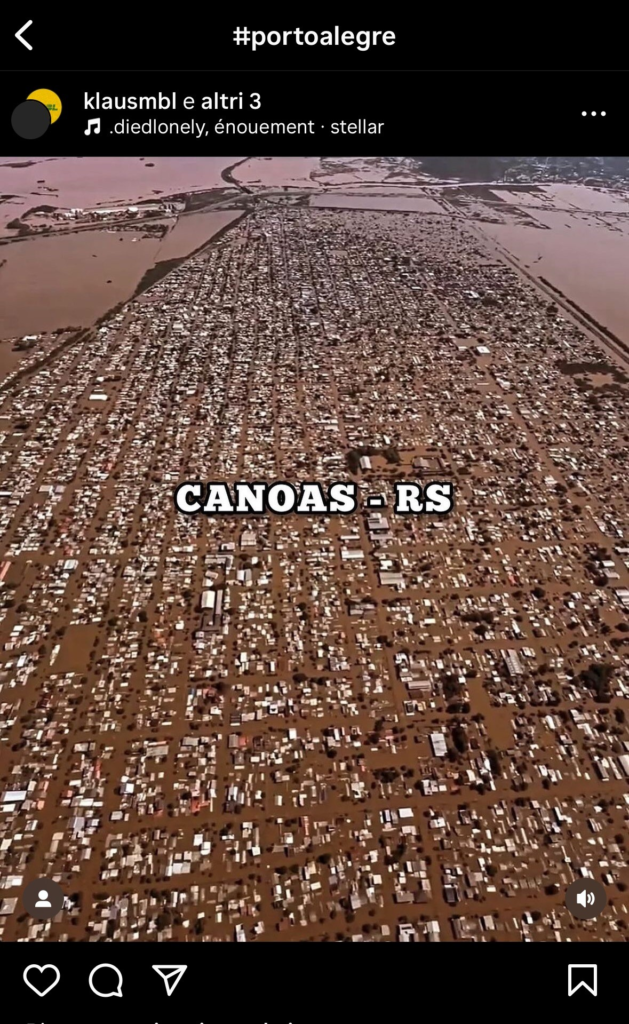
RS has 497 municipalities, and 414 have been impacted by flooding, which is how to imagine 83% of Italian cities under water in a matter of days.
It is easy to understand that the government has not had and does not have the slightest conditions to deal with this tragedy. In fact, there is a lack of boats and vehicles to rescue people who are still isolated without electricity, without water and probably now without a phone for days in more remote places, there is a lack of equipment to repair bridges and roads that block and isolate entire cities of thousands of inhabitants and that for this reason have not been supplied for days. As of 5/5/24, there were 839,000 homes without water and 421,000 without electricity.
It’s a dramatic story, which I never imagined I’d have to write because “we’re used to tropical rain”; in fact, it’s not the first time that rivers have overflowed and the Guaíba has risen. Guaíba has an alert level of 2.5 meters and a flood level of 3 meters. At the moment its peak was 5.33 meters.

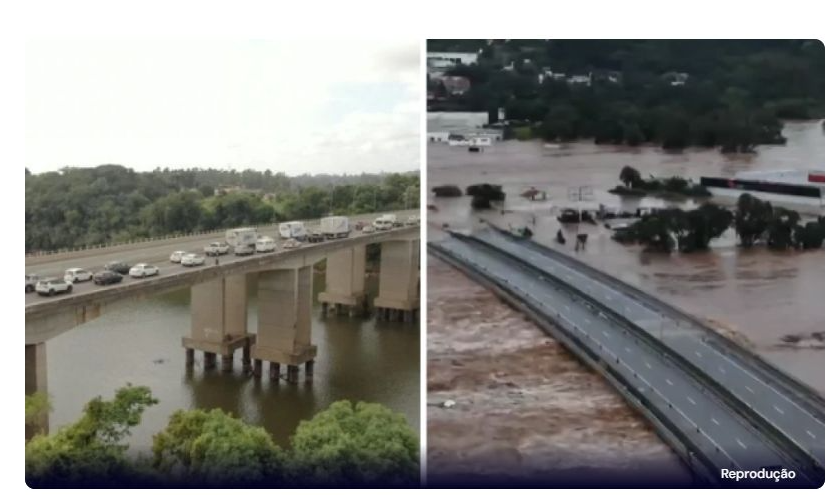
But Guaíba is not a small lake, it has 496 km² (Lago di Garda, the biggest lake in Italy has 370 km²) and flows into the Lagoa dos Patos (even larger 10,144 km²) which in turn pours into the Atlantic Ocean unfortunately through a narrow channel with 2km wide and 12m deep, too little to drain all the water that the flooded rivers have poured into the Guaíba and that flood Porto Alegre and its surroundings after devastating the cities on the nearby valleystag. To get an idea of the volume of water trapped, in Lajeado in the Vale do Taquari, there is a 34-meter-high bridge that crosses the river; this bridge has been completely submerged by the flooding.
I find it useless and it is not my goal now to talk about how many cities (but not all) were built in risk areas, just as many (but not all) were not prepared after previous floods… POA itself is protected by a wall that runs along the harbor (3 meters high and another 3 meters deep) and a system of dams, pumps and gates that unfortunately saved the city only in the first days.
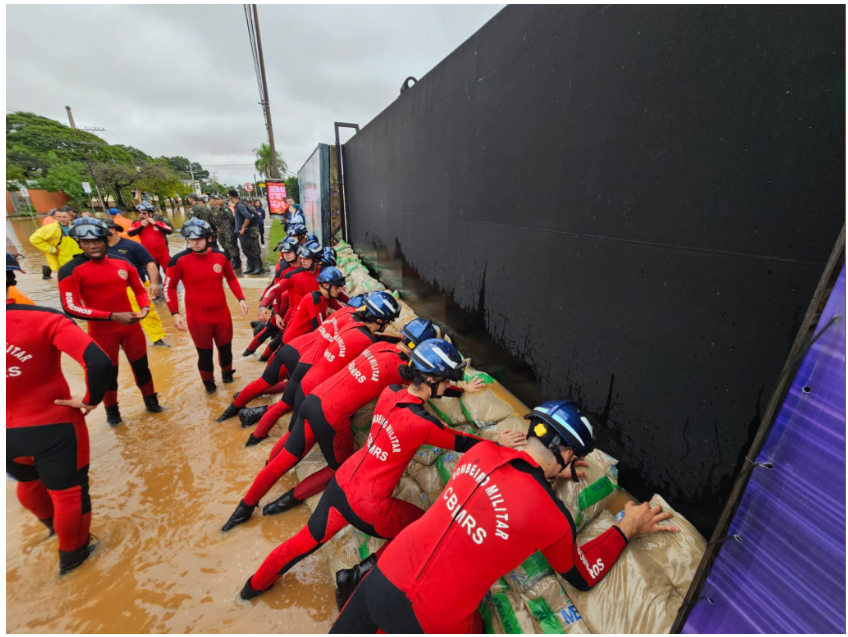
However, the water exceeded it (even in height) and invaded my city. It invaded the international airport, which before the events had a traffic of 8.2 million passengers per year, it invaded my school, it invaded the place where I worked, the stadium of my favorite soccer team. Places where imagining this could happen was impossible! Now everything will have to be rethought.
Well, this is, in a nutshell, what has happened since the beginning of the rains on 27/4 intensifying until the beginning of May with the devastation of many cities and the arrival of water in Porto Alegre from May 2, 2024 until today (May 9), with a forecast of another 10 days or so underwater. In 1941 it took 32 days for all the water to drain and the Guaiba was 66cm lower.
Now, as you know, I haven’t lived in Porto Alegre since 2004, so what I tell you now about the emotional feelings is what I hear from friends and relatives, who are still there. Some without a home and others safe and sound but in quite complicated conditions for those who were used to “a normal life” (imagine 5-10 days with the streets under your house submerged by meters of water, some areas without electricity, others even without water). Many houses in the submerged neighborhoods were made of wood, now destroyed or with water up to the ceiling and beyond. Not to mention the health emergency that is already present (a Dengue epidemic was underway) and that will only get worse with dirty and still water practically everywhere.
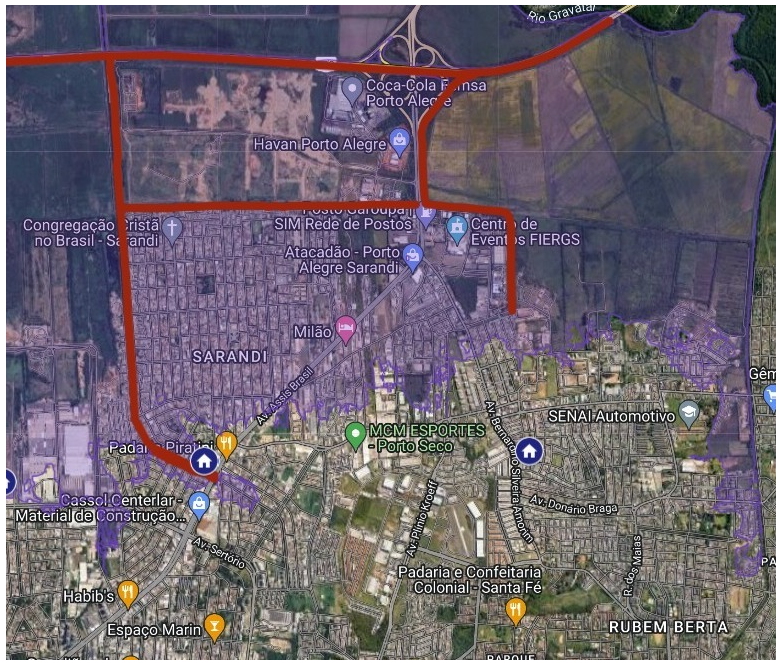
My childhood friend, my best friend, Pedro, has his parents’ house in one of these neighborhoods, Sarandi, which alone has 91,000 inhabitants. I sent several friends the information to help him, if you want to contribute ask me too, 1 euro is equivalent to about 5 reais so every contribution, no matter how small, helps them lot to get back on their feet. It’s impressive to see how an entire neighborhood disappears from the map.
My grandmother’s house (in the municipality of Relvado about 200km from POA) was miraculously spared from the devastation of the river that passes behind the house, leaving “only” the basement full of water and flooded by about ten centimeters on the first floor. The city has not had the same luck. And this is nothing compared to the scenes found in the innermost town halls.
There is only one thing that everyone tells me, without exception, and that brings hope: the solidarity and love of the Gaúcho people towards their fellow citizens. In the midst of the delays and the complete absence of the State (not because it is not present, including with the army, but as I said due to the territorial extension it is almost impossible to do so), videos of improvised rescuers on their vehicles, boats, jet skis, helicopters (an entrepreneur alone has already rescued over 1000 people) are pouring on the internet, human chains to save trapped people, influencers at the complete disposal of the city by driving donations of medicines and drinking water, hundreds if not thousands of volunteers in reception centers.
Local donations that come in and relieve the pressure. The government has promised unprecedented aid to deal with the crisis and rebuild, but this will take time, and in the meantime it is the Gaúcho people who are supporting each other, but this people urgently need to receive more concrete and more structured aid. There are certainly many other information and stories that I could publish, but if you browse on social media starting from the links I have included you will find many other videos and stories about this tragedy.
For now, we can only pray to God that nature will give a respite, that those who are missing will be found still alive, and that the people directly impacted can overcome this pain, even if they can never forget it.
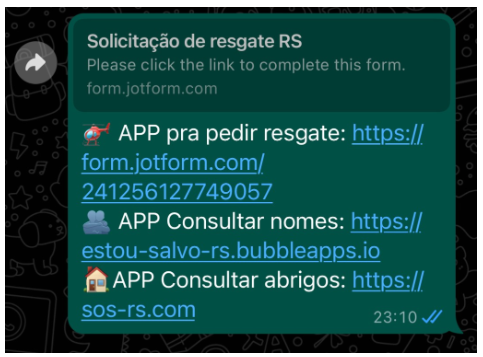
A “tech” note: As an IT professional, I couldn’t help but be amazed at the amount and speed with which real applications appeared to transmit and track in real time calls for rescue, the search for missing people or to find the location of those who were rescued or escaped to some other places.